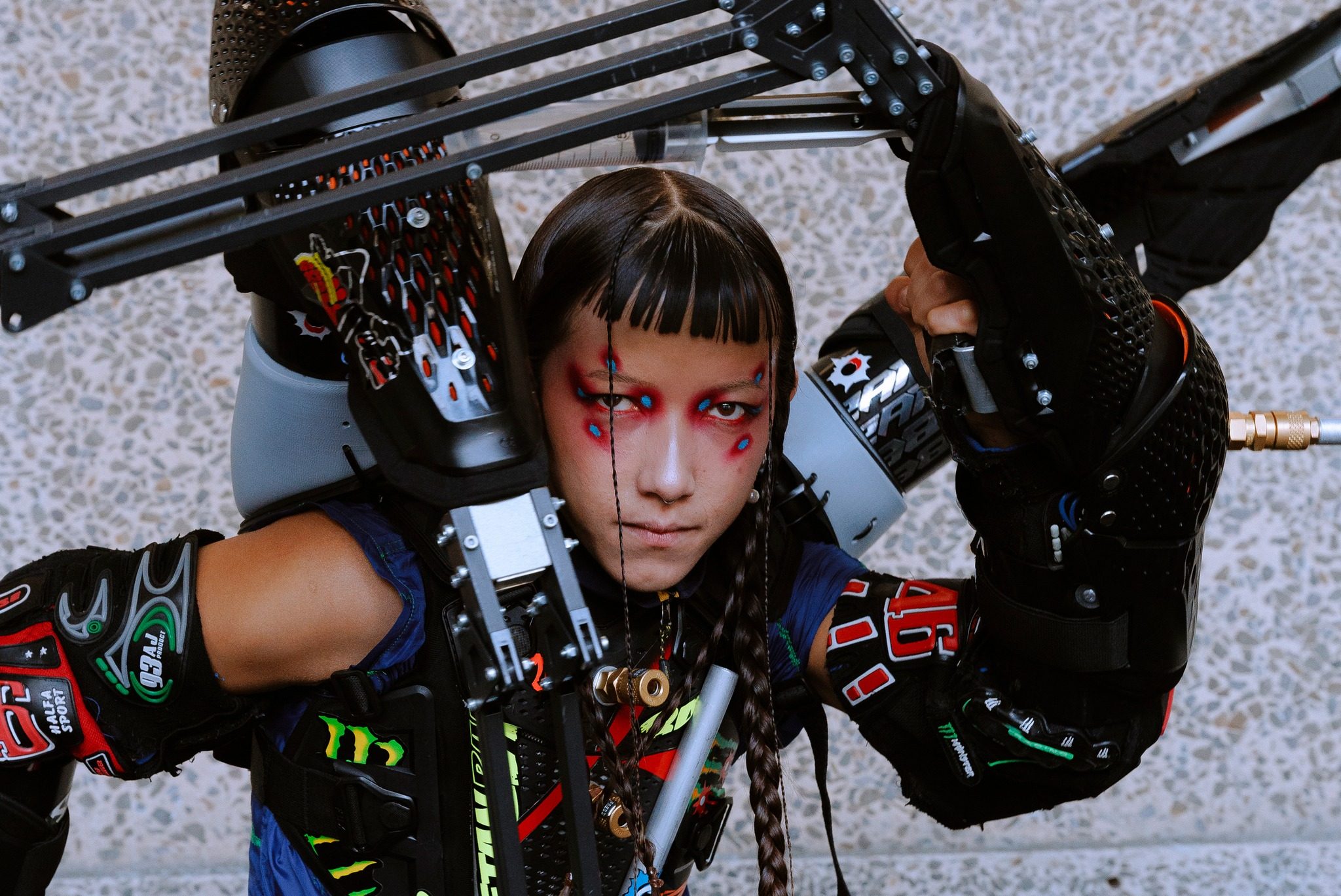
This interview took some days. Usual routine: contacting the festival, the Chunky Move company team, scheduling an appointment with Anthony Hamilton, its artistic director, and getting through four days of Rewire – this edition was astonishing as ever – writing, editing, gathering photographic material, and so on. Around the same time, the international scene shifted again, and this time quite seriously. We’re talking about the conflict in Iran, of course, which is revealing just how fragile the globalized world is, because even the blockade of a strait is enough to begin painting the future bleak. In this context, the performance that gave rise to this interview seems more timely than ever, if not prophetic.
Not only for the title, “U>N>I>T>E>D,” which is a fitting and necessary invitation in any era, but, above all, for its ability to prefigure a collapse and what might come next. A DIY ethic, an aesthetic, and even a spirituality, born from the twilight of the age of cities, from their gleaming architecture and (seemingly) limitless technologies. A future to be peered at through the cracks of the present, in which the energy upon which the world we know is based may no longer exist. We will then need to go back to sewing clothes together; listening to music born from rhythmic beats, as in Indonesian gamelan; dancing collectively and symbolically; equipping ourselves with devices and extensions that seem to come from the future, but in reality recombine discarded materials and recall “primitive” life forms like arachnids. Machine, man, machine again, and then man again. As always from day one on earth, strive to find harmony within the chaos.
"U>N>I>T>E>D" ha debuttato in Europa alla Biennale Danza di Venezia del 2025, il secondo passaggio è stato invece in uno dei festival musicali più completi e interessanti del mondo, il Rewire a Den Haag.
A festival like Rewire offers us a different and truly unique setting: we usually work within dance programs, sometimes in multidisciplinary venues, and yes, even at festivals, but not ones so focused on music. We’ve already collaborated with smaller music festivals, both in Australia and abroad, but now there’s a real trend toward hosting new forms of performance within traditional music festivals, because audiences want to experience a variety of things there as well. It’s a very interesting development. Contemporary dance in Australia, and generally abroad as well, has a very limited audience, so being present at these festivals is both a strategic move for me and something I’m truly passionate about.
How did “U>N>I>T>E>D” come about?
About three years ago, I was reflecting on some of the projects I’d worked on and on this sort of constant fascination I have with immersive experiences that incorporate ideas about materiality: not just technology, but also tools, their history, and the relationship we’ve built with the environment as a species. For me, it’s a recurring theme. I’ve often found myself collaborating with designers to develop technological devices that dancers and artists would wear in large processions and parades. Most of the time, however, they tended to be rather bulky and not very agile, not well-suited for complex choreography. So I worked with the same collaborators but with a different brief, trying to develop devices that were more body-like. From the meeting in Bali with Gabber Modus Operandi, however, a thematic interest in music and club culture emerged. We were already fans of each other’s work; we followed and appreciated each other on Instagram, etc. Then we decided to spend some time together to see if there was a sort of affinity, and from there things developed very quickly. In Bali, we brought a prototype costume, and we were all very enthusiastic about it. We immediately realized we had found a connection and shared an interest in the material aspect of form. We also talked a lot about more philosophical ideas regarding urbanization and the potential for new forms of religion and spirituality to emerge in the urbanized environment.
Was that your first time in Bali?
No, I’d already been there on vacation and for a small performance at a resort called Potato Head. It’s about fifteen years old and was one of the first to adopt sustainable practices in Bali: they build and create all the decorative elements for the rooms – vases, cups, towel racks, etc. – using recycled plastics and ceramics, for example. And the workshops are right there: it’s truly incredible. As I mentioned, I did a couple of small projects there for their cultural program, specifically to unveil a sculpture by the New York visual artist Futura 2000, a pioneer of graffiti art.
Has Bali had any influence on your view of how technology, materiality and spirituality are interconnected?
I believe that the conversations I had with Kas and Ican (the two members of Gabber Modus Operandi, ed.) shared a common thread that is universal: urbanization and the need to construct a mythology and stories around our experience of urbanization. The work is titled “U>N>I>T>E>D” precisely because it speaks to a unified experience, a global connection. I believe, however, that the sense of the mystical in the urbanized environment is probably stronger in places like Indonesia or Bali. Especially in certain emerging countercultures, linked for example to motocross or freestyle, which are very widespread in Jakarta, Java, etc. We are both very interested in this idea of a world that is a mix of utopian aspiration and DIY culture, made up of patches and repairs. There you see piles of trash, wires, stuff hanging down, DIY electronics to bring power into the house. So it’s a dimension that’s very visually present and is never hidden. In a place with strong urban planning like Melbourne, on the other hand, they spend a lot of money to hide everything. Often, though, it’s more interesting to be able to see reality through the cracks.
Speaking of music, what did you ask Gabber Modus Operandi to include in the show?
What drew me in was that their music is filled with long pauses. I’m very interested in the idea of music as technology, as a tool capable of doing many things. One of these is to communicate and signal. We talked a lot about how, in Bali, the gamelan varies from community to community: every village has its own sound, its own tuning system. You can recognize the villages by their tone, it’s truly incredible. There’s this extraordinary idea of music as something different, as if it had a sort of utility, a practical purpose. In any case, Kas sent me many drafts, sketches of compositions he was experimenting with, and made them available to me, like a veritable library with which to build a certain dramatic arc featuring peaks, dips, and moments where the audience experiences a sort of relaxation, only to be immediately drawn back into a certain intensity. It’s like writing an album: a journey in which energy is built up and then released, built up and then released again.
What did you ask Future Loundry, the other Balinese creative project involved in “U>N>I>T>E>D”?
Future Loundry collaborated with a Melbourne-based company called Creature Technology. Creature Technology developed the exoskeleton suits, while Future Loundry created the costumes (T-shirts, sweatshirts, pants, etc.). Future Loundry is a brand founded by Ican of Gabber Modus Operandi and his wife Manda. My impression was that Gabber Modus Operandi’s music could not be separated from the visual aspect linked to fashion, because it is part of a single story, a single mythology. Both Creature Technology and Future Loundry share a common sensibility and ethos, which leads them to reuse existing materials and reinvent them through a creative approach to upcycling. Aside from a few small 3D-printed elements, everything in “U>N>I>T>E>D” is recycled, from the exoskeletons to the costumes to the set design. For example, we used car fuel tanks that my production manager and I salvaged from junkyards here in Melbourne. It’s all very DIY. My inspiration comes from artists like RAMM:ΣLL:ZΣΣ, an avant-garde street artist from 1980s New York and also a true outsider in the hip-hop scene.
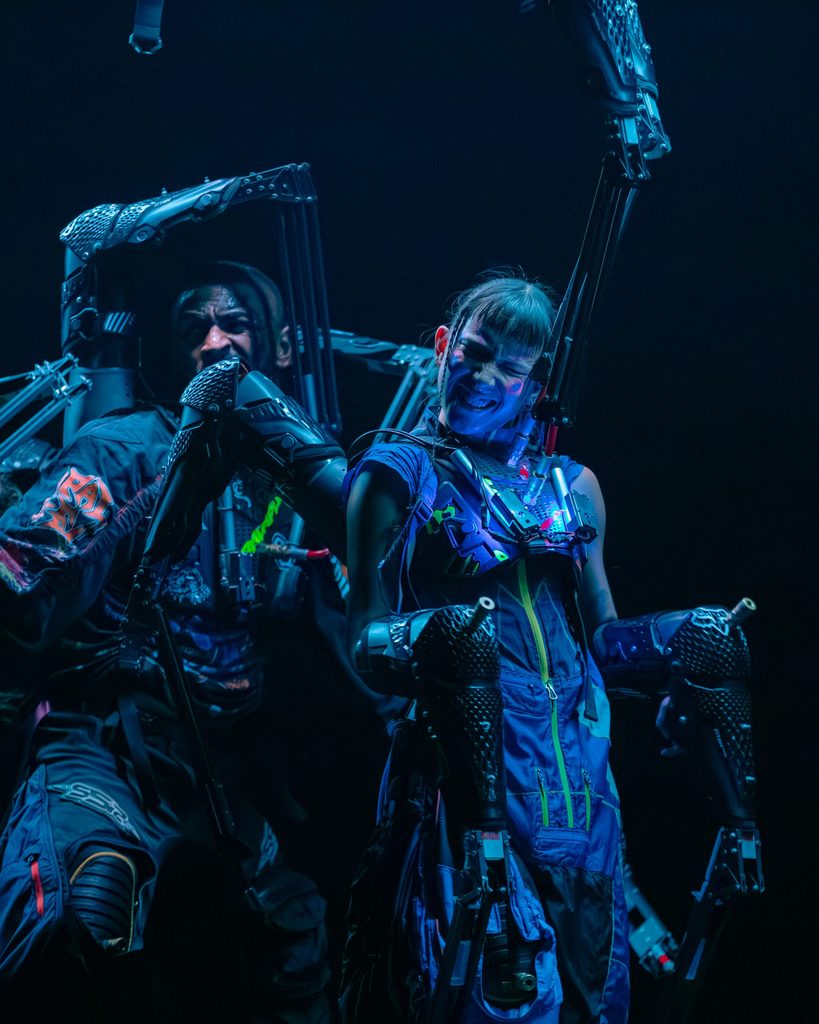
Chunky Move, Rewire 2026. Photo by Sabine van Nistelrooij
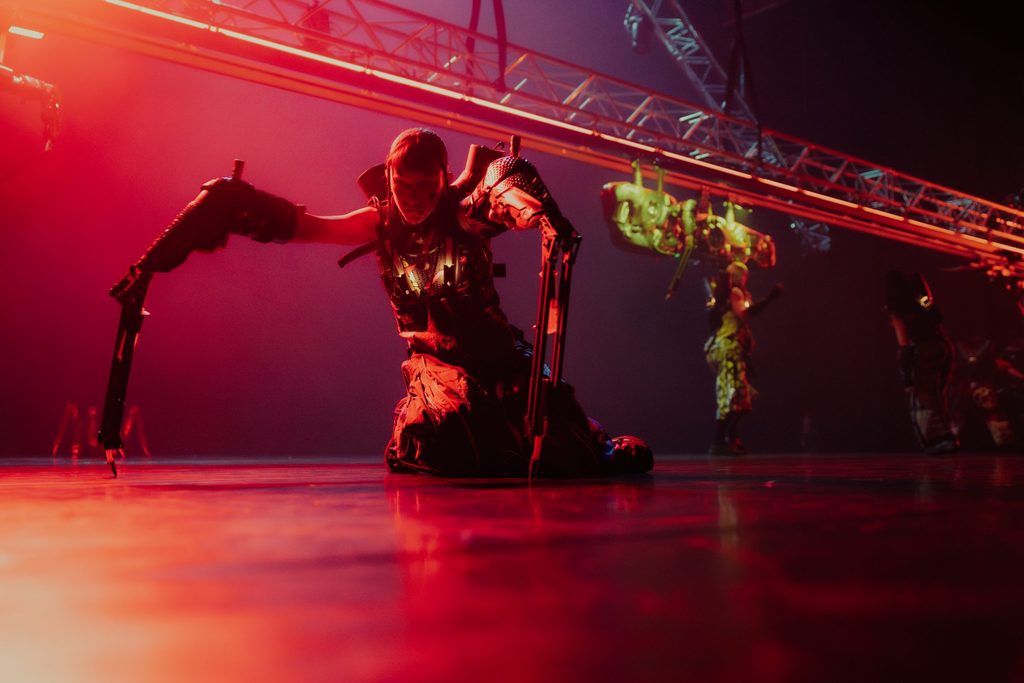
Chunky Move, Rewire 2026. Photo by Alicia Karsonopoeroj
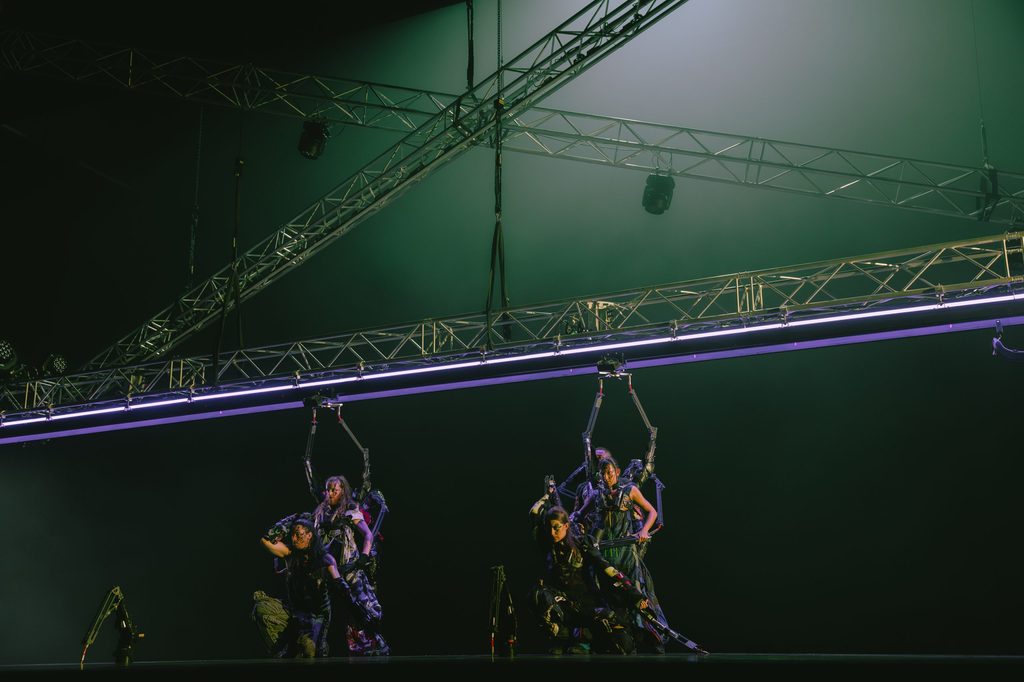
Chunky Move, Rewire 2026. Photo by Sabine van Nistelrooij
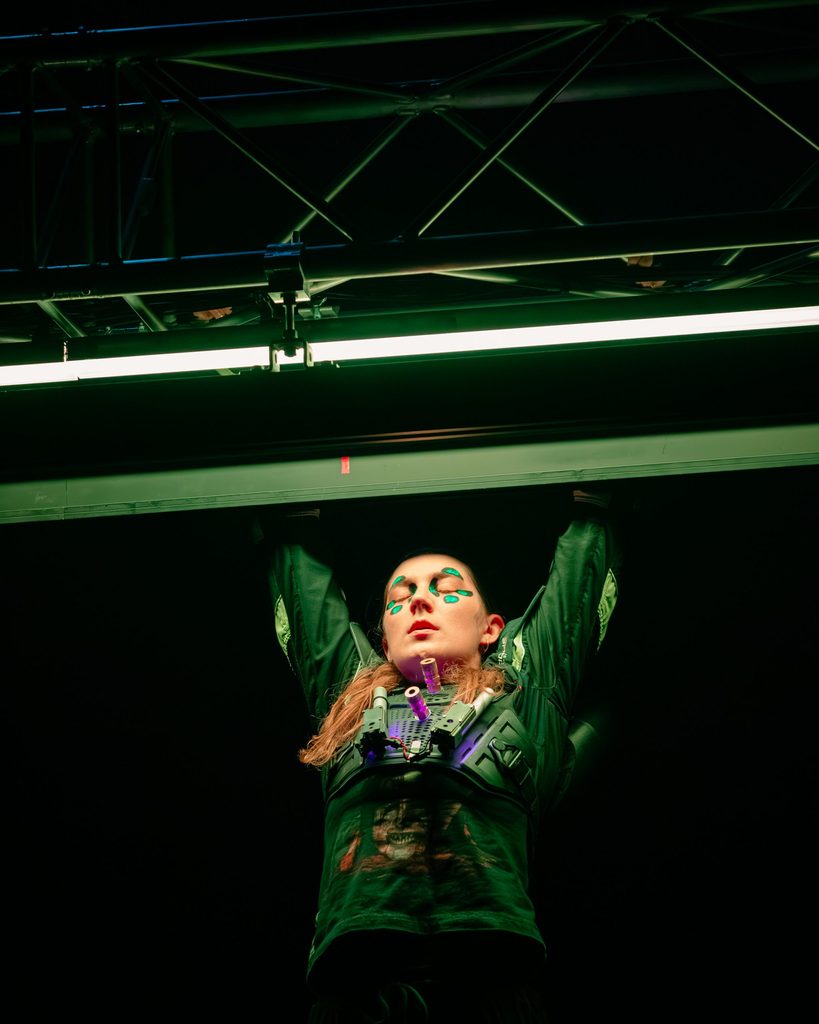
Chunky Move, Rewire 2026. Photo by Sabine van Nistelrooij
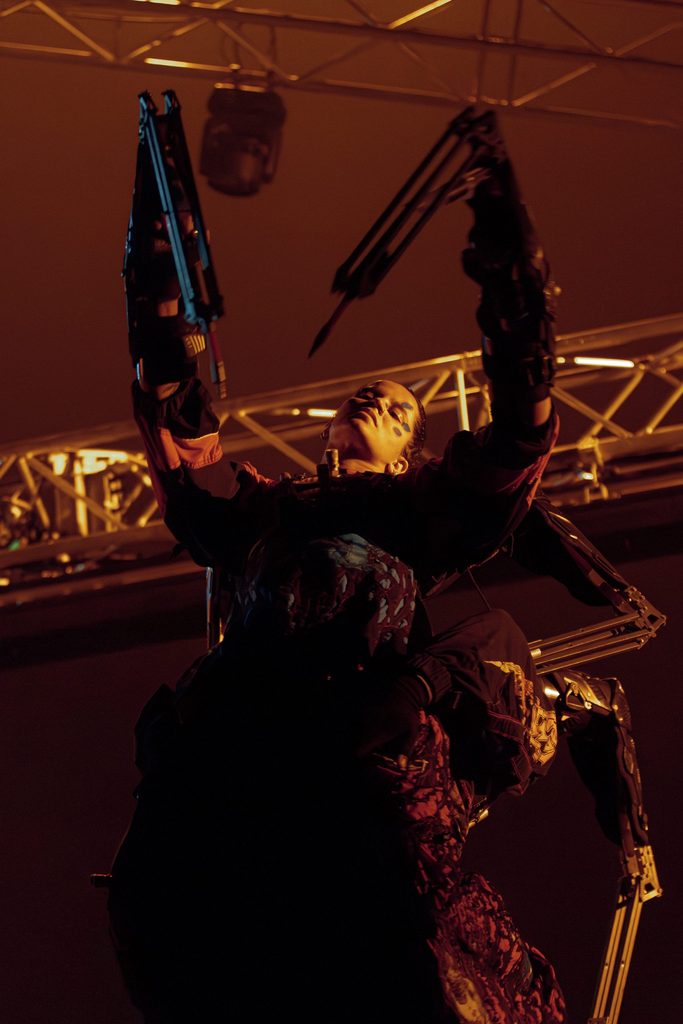
Chunky Move, Rewire 2026. Photo by Sabine van Nistelrooij
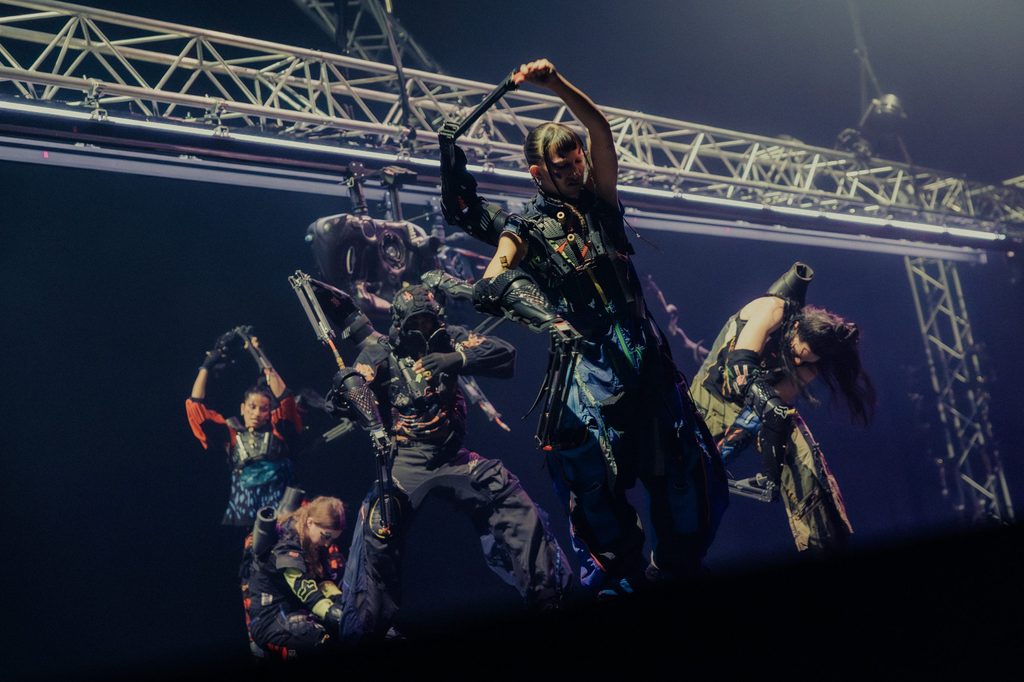
Chunky Move, Rewire 2026. Photo by Alicia Karsonopoeroj
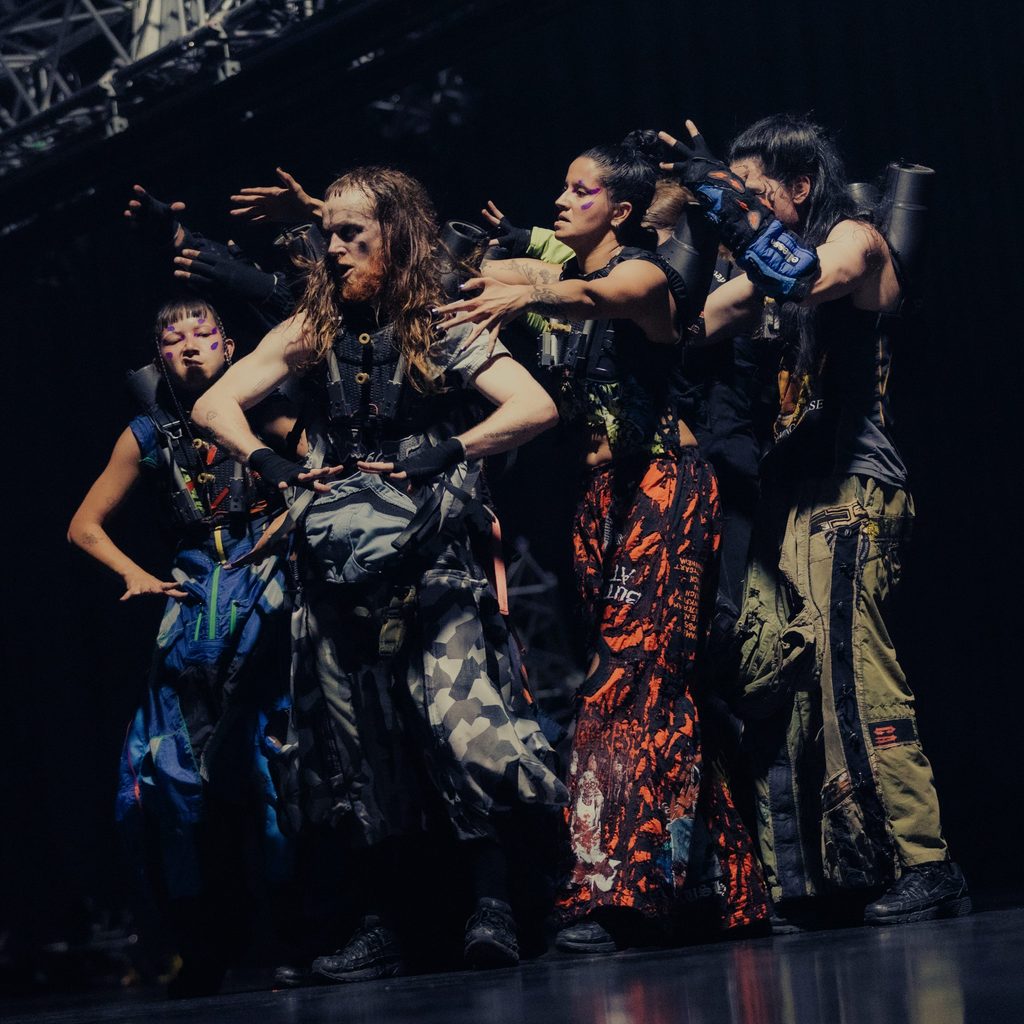
Chunky Move, Rewire 2026. Photo by Alicia Karsonopoeroj
Chunky Move, Rewire 2026. Photo by Alicia Karsonopoeroj
While watching the show, I picked out a few key words I’d like to hear your thoughts on. The first is “future.”
I believe that the future is now: it’s a projection of things that stem from the present. I always try to bring people back to the present and remind them that we’re imagining the future using things that exist at this very moment. I believe that our perception of time and the way we organize it through language and linear concepts is a kind of habit. It’s something habitual that may not, however, be objectively real. Of course, we are guided by day and night, by the cyclical nature of celestial bodies, so in reality we can’t really escape this kind of assimilation of time. Looking specifically at my work, I am now aware that I operate in an environment – that of art – that is truly volatile and risky, in terms of funding, resources, and survival in general. This prevents me from thinking too much about the future because otherwise I wouldn’t take any risks. When you’re very worried, you also become very cautious. I think the future requires courage from people, the ability to do things now, to try now, and to experiment now. I also think you can only control what’s directly in front of you. And it’s important to surround yourself with people of good will in your inner circle.
The second word is “technology.”
I think that in “U>N>I>T>E>D” there is a rather retro view of the relationship between technology, the body, and biology, and that this relationship is also portrayed in a rather “direct” way. In short, we’ve had mechanical limbs, pacemakers, hearing aids, and all kinds of prosthetics in our bodies for a long time. Usually these things aren’t visually obvious; we try to hide them well. I’m much more interested in reminding people that they’re sitting in a chair, working on a computer, and can talk to someone on the other side of the world. Even when we pick up a pen, we’re already a kind of cyborg. I wrote a short essay for last year’s Venice Biennale that discussed the history of the cyborg and the idea that my external perception of myself, my surroundings, and my impact on that environment already represents a sort of first step toward technology. The history of technology is the most interesting thing to me: how it relates to self-awareness and the activation of self-awareness that occurs within us as a species.
You mentioned two other words: “perception” and “consciousness.”
Just like the future, the changes in perception brought about by technology are already underway. They’re happening right now. Just take a look at the data on the effects that spending many hours in front of a screen or excessive phone use have on our psychological well-being, for example. A few years ago, I read a truly fascinating book written by John Gray, a British economist turned philosopher. The book is titled “Straw Dogs: Thoughts on Humans and Other Animals” and explores the idea that ethics moves back and forth, oscillating between good and evil, while technology is cumulative, continuous, and constant. We acquire more and more knowledge through science and technology, but the ethical relationship we have with it changes. And this is precisely where the danger lies: when our ability to do things increases and technology increasingly slips beyond our control. For example, today you can access pornography 24 hours a day, 7 days a week, at any age. And the situation is becoming increasingly extreme. It is a technology that has gone far beyond what even fifteen years ago would have been considered completely unacceptable, something we could never have imagined. I find the internet a truly fascinating space, because I see it as the place where all the darkest corners of our psyche converge. Everything flows into this portal, and we can access it at any time, whereas before, all our darkest fantasies lived only in our heads and could never escape.
I also think that the current problem with technology is its speed. It’s evolving so quickly that we can no longer keep up with it.
That’s right, that’s exactly how it is. Technology moves much faster than the old political and governmental systems. You can no longer gather in a room and take a few days to figure out what to do. You have to know right away. We live in a sort of hyper-reactive world.
Have you ever used artificial intelligence in your work?
No, I don’t use it for creative work, but rather to explore writing and do research. Talking to AI is like diving into a library and trying to find a page from a long-lost book, without knowing where to look for it. I find what Adam Curtis, a BBC documentary filmmaker, said in a fantastic interview he gave last year very interesting. Right now, for him, AI can do nothing but look backward. It rummages through archives, through the texts we’ve already written, the words we’ve spoken, the ideas we’ve thought, the political systems we’ve already lived through: AI is our past coming back to haunt us. It is not the future, because it is incapable of imagining it. The future is still a task for us humans. It’s a truly interesting idea: perhaps the time has truly come to leave the past behind us.
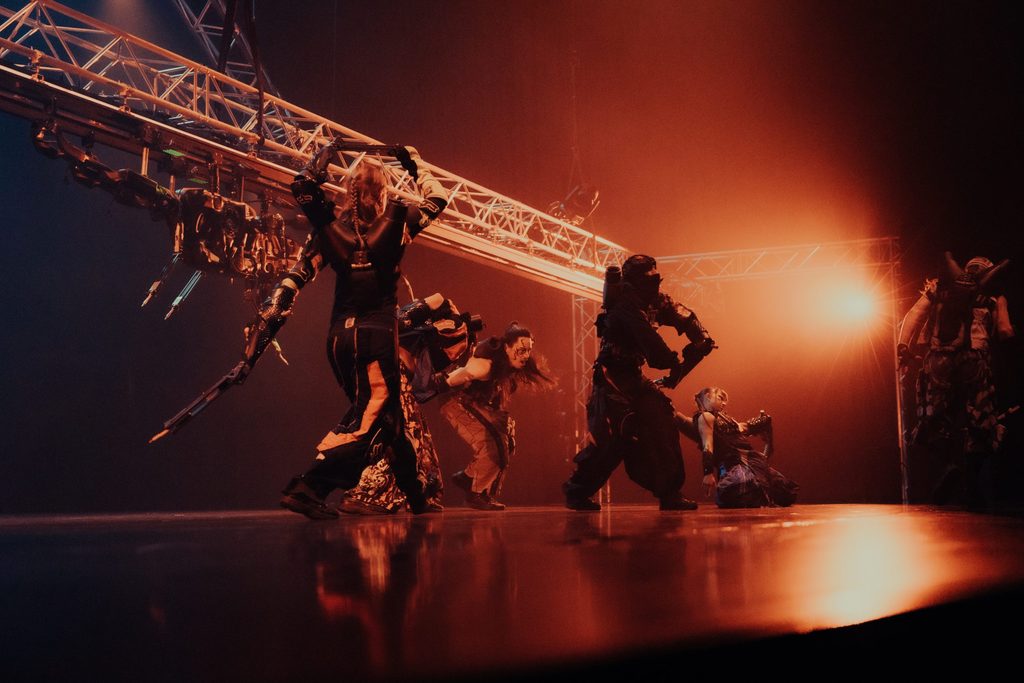
L'ultima parola è "società" e mi è venuta in mente pensando alla trave che sempre al di sopra dei performer e alla quale sono legati. Ogni tanto poi i performer si agganciano anche tra di loro, formando un corpo unico, coordinato, al di là delle singole individualità.
That’s a very interesting interpretation. Actually, to me, that beam represents something that is both literally and metaphorically above us. I used it to create a sense of the mystical, to suggest something that is in the heavens, unreachable; something we can never fully understand because it’s beyond our reach. I like the idea that we relate to technology in much the same way, that it is increasingly an unknowable entity, one that determines its own course and sets off on its own path while we try to keep up with it. In any case, the underlying vision of the show is optimistic. I chose the title, “U>N>I>T>E>D,” with full awareness; I wanted it to be a moment of aspiration, to show that even within the chaos, the turbulence, all these rough movements, which can feel a bit like rolling in the mud, there is a kind of tenacity and resilience. As if to say: yes, it’s difficult, but together we’ll make it. Despite all the difficulties, we’ll keep pushing forward, creating beauty, community, and connections amid the rubble, the difficulties, and the chaos. A sort of anti-utopian, anarcho-aspirational positivity! (laughs, ed.). It’s about finding harmony in chaos.
